“OIC InsurTech
Award 2026”
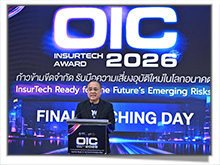
“OIC InsurTech Award 2026” seeks outstanding insurance innovations to tackle future global risks and propels winning entries into the real market.
Mr. Chuchat Pramoolpol, Secretary-General of the Office of Insurance Commission (OIC), revealed that the OIC InsurTech Award 2026 aims to provide a platform for innovators to utilize technology in addressing emerging risks—such as the climate crisis, the aging society, and cyber threats—thereby driving a transition toward a more proactive insurance industry. A key achievement of this initiative is its evolution into a “comprehensive innovator incubation platform.” From an initial pool of over 500 applicant teams, a rigorous screening process narrowed the field to the final 10 teams capable of transforming their ideas into practical, problem-solving innovations. This success stems from a collaborative effort with six key partners: TLAA, TGIA, TII, depa, NIA, and TED Fund.
The competition is merely the beginning; the OIC and its partners have prepared a comprehensive “After Program” to drive these innovations toward real-world application. This includes business matching with insurance companies, connecting innovators with funding sources, providing in-depth consultation, and offering internship opportunities for students. Particular emphasis is placed on solutions addressing critical national risks, such as natural disasters or unforeseen events. These solutions can leverage data and technology to enhance risk assessment, improve response planning, and develop systems that react to situations with greater speed and accuracy. The ultimate goal of the OIC is not merely to identify winners, but to cultivate innovators and drive the development of solutions that deliver tangible benefits, thereby elevating the Thai insurance system to sustainably handle future risks.
The OIC InsurTech Award 2026 is organized under the theme "InsurTech Ready for the Future’s Emerging Risks: Breaking Limits to Tackle Emerging Risks in the Future World." It provides a platform for university students, the new generation, developers, tech firms, and startups to harness technology and creativity in developing solutions for four key risk areas: emerging risks, risks associated with an aging society, disaster-related risks, and digital-era risks. The initiative aims to promote projects that excel in innovation, business viability, and practical applicability. This year, the project attracted interest from over 500 teams of students, innovators, and developers nationwide. Following a rigorous selection and incubation process—encompassing concept development, solution design, prototyping, and business planning—ten teams emerged as finalists (five student teams and five general public teams). These finalists advanced to the "Final Pitching" round to present their work to a panel of distinguished judges, competing for a total prize pool of 500,000 baht.
The final round was adjudicated by a panel of distinguished experts from the OIC, insurance industry associations, and partner organizations specializing in technology and innovation, including Mrs. Mayurin Suttirattanaphan. The judging panel for the OIC InsurTech Award 2026 final round—held on October 1, 2026—comprised Dr. Nirat Saptaweetham, Special Expert at the Office of Insurance Commission (OIC); Ms. Praphaphat Kulpaworaphas, Senior Expert at the OIC; Mr. Witchukorn Nilmanat, Committee Member for Insurance Business and Academic Development and representative from the Thai General Insurance Association; Mr. Chaturathorn Teerapatkul, Assistant Managing Director (Enterprise Architecture) and representative from the Thai Life Assurance Association; Dr. Ekanong Tangroekwaraskul, Director of Project Development at the Technology and Innovation Entrepreneur Development Fund; Mr. Thatchanawat Piriyathanaphat, Head of Digital Economy Promotion at the Digital Economy Promotion Agency (depa); and Mr. Sirapat Chanakul, Senior Innovation Promotion Officer at the National Innovation Agency (Public Organization).
In the final round, the committee evaluated entries based on five key criteria: Problem–Solution Fit & InsurTech Value (understanding of the problem and value to the industry); Prototype (readiness of the prototype); Business Model (business viability); Innovation & Differentiation (uniqueness and distinctiveness of the innovation); and Presentation (ability to present and answer questions). The objective was to select entries with high potential that are ready for further development and real-world application. In the finals of the OIC InsurTech Award 2026 (an insurance technology innovation contest), the results for the Student Category were as follows: The Winner was Team SufferpuffGirls, recognized for a 24-hour fire risk monitoring system that detects electrical anomalies in factories; the system forecasts and prevents incidents while storing data as digital evidence to support continuous risk assessment by insurance companies. They received a prize of 100,000 Baht, a trophy, and a certificate.
The First Runner-up was Team GuardianX, which developed an application helping users understand disaster risks associated with their residences and select insurance plans tailored to their homes; they received 70,000 Baht. The Second Runner-up was Team AFTERSHOCK, an InsurTech platform that transforms real-time flood data into "Risk Intelligence" for insurance companies; they received 50,000 Baht. Two Honorable Mention awards were also presented: Team Khao_pan_bood, for an elderly care robot integrated with a Smart Home system, and Team Penguard, for an IoT emergency-alert device disguised as a plush keychain, designed for discreet and unobtrusive use; each team received 15,000 Baht.
In the General Public Category, the Winner was Team BURT-BDMS Utilization Review Technology, recognized for an AI system designed for Utilization Management; this system enables hospitals and insurance companies to assess the necessity and appropriateness of medical treatments using standardized criteria. They received a prize of 100,000 Baht and a trophy.
Go To Lead
|