Huawei Cloud Launches
Comprehensive Enterprise AI Product Suite
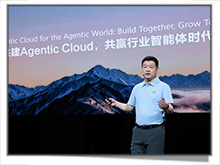
Dr. Peter Zhou, Board Member and President of Huawei Cloud, revealed that in the "Agentic" era, the role of infrastructure is no longer limited to merely allocating computing power. It must now optimize the efficiency of every token, coordinate between general-purpose and AI computing resources, enable continuous model learning, and—crucially—support the secure and reliable operation of AI agents in real-world environments. Consequently, Huawei Cloud has developed "Agentic Infra," a new infrastructure approach focusing on four key elements: token-level computing optimization, enhanced memory capabilities, unified allocation and management of general-purpose and AI computing resources, and secure automation. Agentic Infra currently serves over 3,500 customers.
The latest AI Cluster Service (AICS) features a five-level rapid recovery mechanism and system-wide operational monitoring. It supports stable, continuous cloud-based model training for over 40 days and enables recovery from failures within 10 minutes. Furthermore, through optimized collaboration across resource allocation, caching, and algorithms... This enables a 20% increase in token processing capacity compared to the previous generation; the latest AICS version will be commercially available in China starting September 30 and in markets outside China from November 30.
The Context Memory Storage (CMS) solution is designed to meet the needs of AI agents requiring long-term continuous operation, addressing both memory capacity and data access efficiency. It supports petabyte-scale memory—double the capacity of comparable industry products—and enables high-speed memory read performance at the terabyte level, outperforming similar industry offerings by 50%.
Agentic MaaS aggregates diverse AI models onto a single platform, allowing developers to access state-of-the-art (SOTA) models from leading providers with just one click, eliminating the need for manual installation or deployment. At the event, MiniMax also demonstrated an advanced multimodal model; when integrated with Huawei Cloud, this collaboration expands access to cutting-edge multimodal capabilities.
Huawei Cloud continues to advance its enterprise-grade AI agent platform through a dual approach—combining commercial and open-source models—built upon the foundations of AgentArts and the open-source version of openJiuwen. The platform provides access to over 5,000 general-purpose Model Context Protocol (MCP) resources and more than 1,000 industry-specific MCP resources, making it easier for organizations to develop, deploy, and manage AI agents. Currently, the platform serves over 100 clients across government agencies, enterprises, research institutions, and educational bodies—including the Longgang District Government (Shenzhen), China Southern Power Grid, Guangzhou Laboratory, the University of Science and Technology of China, Kingsoft Office, Sichuan Yingu Carbon Sink Renewable Resources Co., Ltd., Changsha Thunder Cloud Network Technology Co., Ltd., and KingMed Diagnostics. During the event, Kingsoft Office shared its practical implementation of the Huawei Cloud agent platform, detailing the deep integration of the platform with WPS 365 Document Center and WPS Comate to develop specialized AI agents for office tasks; these solutions are now deployed across various industries, including the financial sector and government agencies.
Go To Lead
|